Tuesday, August 30, 2016

12 Tang Dynasty


Tang Dynasty


Viewing the Chinese history record, you will find the Tang Dynasty was the most glistening historic period in China's history. Founded in 618 and ending in 907, the state, under the ruling of the Tang Emperors, became the most powerful and prosperous country in the world. Particularly, in this glorious period, the economy, politics, culture and military strength reached an unparalleled advanced level.

 t the end of Sui Dynasty (581 - 618), the whole country fell into chaos due to the tyranny of Emperor Yang; rebellions roused by peasants were everywhere. Resenting Emperor Yang's ruling, the chief officer of Taiyuan - Li Yuan, who was also known as Tangguo Gong (a vassal in Sui Court) raised an army in Taiyuan from May 617. In November of the same year, Li Yuan's army captured the capital city Chang'an (currently Xian) and put a new monarch, Yang You, on the throne as Emperor Gong. Meanwhile, Li Yuan proclaimed himself Da Chengxiang (prime minister) and Tang Wang (King of Tang). In 618 after Emperor Yang was killed by his chancellor, Yuwen Huaji, Li Yuan seized the chance to proclaim himself emperor and changed the state title into Tang, still with Chang'an as the capital city.

 Glorious Period
The first glorious period was from 627 to 649 when the Tang Dynasty was just set up and its national strength was recovering from the previous weak condition. Under Emperor Taizong Li Shimin's wise governing, the national strength and social development reached an unparalleled prosperity - economy and commerce flourished, the social order was stable, corruption never existed in the court and the national boundaries were even open to foreign countries.


 After Li Shimin died, the throne passed to his ninth son Li Zhi who was later crowned as Emperor Gaozong and married Li Shimin's imperial concubine Wu Meiniang. Wu Meiniang was officially named Wu Zetian and afterwards became the empress. Actually it was Wu Zetian who had the real power during Emperor Gaozong's reign since the emperor suffered from bad health. After Li Zhi died, Wu successively enthroned and dethroned her two sons - Li Xian and Li Dan. In 690, disregarding the objections and criticisms of all chancellors, Wu Zetian proclaimed herself Emperor Shengshen and established a new dynasty - Zhou, which lasted for 15 years. During her reign, the state economy continued to develop rapidly.
In 705, a coup broke out which brought one of the former emperors, Li Xian, to the throne as Emperor Zhongzong. However, Emperor Zhongzong's ruling was manipulated by his wife, Empress Wei. In 710, plotting to be the second woman emperor, Empress Wei along with Princess Anle poisoned Zhongzong. At that time, Li Longji (son of Li Dan) launched a coup with the assistance of his parental aunt Princess Taiping, killing Empress Wei and Princess Anle. After that, Li Dan was crowned as Emperor Ruizong.
The second glorious period was during Emperor Xuanzong's reign. In 712, Emperor Ruizong abdicated and Li Longji was enthroned as Emperor Xuanzong. Under his ruling, the national economy, politics and culture all developed rapidly and the social development entered a new heyday. In that period, Chang'an City was the largest and the most prosperous metropolis in the world. Since the title of Xuanzong's reign was Kaiyuan, that period was called the Heyday of Kaiyuan, in which the dynasty reached its summit of prosperity.

 Decline and Ruin
In his old age, Emperor Xuanzong was complacent and indifferent to state affairs. Hopelessly, he indulged himself in the beauty of his concubine Yang Yuhuan. Besides, he also appointed some wicked chancellors who corrupted the political order. Meanwhile, troops on the frontiers gradually gathered together and formed a powerful military force. In 755, An Lushan aligned with Shi Siming and launched a rebellion, called the An Shi Rebellion which lasted for eight years and heavily knocked the Tang regime. From then on, the national strength was weakened daily by separatist forces in local areas. Because of the incompetence of the emperors the dominance of the eunuchs and power struggles between chancellors became increasingly intense. Hence the Tang Dynasty declined from generation to generation. In 859, a large-scale peasant uprising launched by Huang Chao again severely attacked the Tang regime. In 907, the last Tang emperor, Emperor Ai was forced to abdicate by Chancellor Zhu Quanzhong, who afterwards changed the state title into Liang, finally putting the ever powerful and mighty dynasty to an end.


11The Sui Dynasty

The Sui Dynasty


The Sui Dynasty (581–618) was a dynastic clan that ruled for 37 years over much of the region. The course of their empire was strangely reminiscent of the Qin Empire; the Mandate of Heaven seemed to come into play.

Like the Qin Dynasty in Many Ways...

The Sui Empire started when the ruling clan conquered Nanjing in 589. Along with the Qin Dynasty, the Sui Dynasty was one of the two dynasties of shortest duration that ruled big empires in the region.
The Qin Dynasty had ruled much of the same region 800 years before though their great empire only lasted for 15 years.
As the Qin Dynasty did, the Sui Dynasty used the people to carry out huge construction projects and fight large-scale wars to invade other countries. Their Great Wall and Grand Canal ranked among the world's greatest feats of engineering at the time.
Their rule was harsh, and their dynasty ended in big rebellions also.


he Pre-Sui Era: AD 25–581

Perhaps the Sui rulers initiated their large-scale projects in an attempt to make their empire more secure since the region had a history of 500 years of large empires disappearing.
The Eastern Han Dynasty (25–220 AD) lasted for about 200 years. At its end, the Eastern Han Empire split into three warring states. That was called the Three Kingdoms Period.
Then in 376 AD, there were two large empires that divided the region north and south.

The Northern Zhou

In 560, there were four kingdoms in the area. This was called the Southern and Northern Dynasties era (420–589).
One of the four kingdoms of this era was called the Northern Zhou. The Northern Zhou controlled a big inland region that reached from Mongolia and down into the southwest. It was far from the sea. 


he Beginning of the Sui Empire (581)

In 581, the Sui Dynasty began when a member of the ruling clan of Northern Zhou killed about 60 of his brothers and relatives and made himself the emperor of his kingdom.
He was called Emperor Wen. He wanted to strengthen his empire, so he gained the support of Confucian bureaucrats and expanded his army


Sui Emperor Wen (589–604)

Emperor's Wen goal was to control the region. Do this this, he initiated large construction projects, installed Confucian bureaucrats, and initiated major wars.
The Chen Empire was to the southeast, and the big Yangtze River was a natural boundary.
It is said that Emperor Wen sent about 500,000 troops across the Yangtze River in 588. In 589, he conquered the Chen Empire capital called Jiankang that is now called Nanjing. This is how the Sui Empire began.
During his reign, he initiated construction projects involving millions of laborers reminiscent of the Emperor of the Qin. His major policies were spreading Buddhism, reinstituting rule by Confucian bureaucrats, and making the people poorer for his wars and construction projects. 


The Spread of Buddhism

xian
Emperor Wen was a Buddhist and tried to spread Buddhism. Mahayana Buddhism had spread and became popular in the region in the various kingdoms during the preceding several hundreds of years.
The religion was taught by monks and others from Central Asia and by various kings and emperors starting from the Eastern Han era.
In the year 601, Emperor Wen expressed an edict that said:
All the people within the four seas may, without exception, develop enlightenment and together cultivate fortunate karma, bringing it to pass that present existences will lead to happy future lives, that the sustained creation of good causation will carry us one and all up to wondrous enlightenment.


Sui Emperor Yang (604–618)

His son came to power in the year 604. He was named Emperor Yang. He ruled for 14 years and continued his father's policies of installing a Confucian bureaucracy, making wars, and building major construction projects, but because he poured so much of the empire's resources into these projects, he exhausted his resources and the people rebelled.
He was more like the Qin Emperor than his father, and he was also known for expending a lot of money on luxuries.

Yang's Construction Projects

the Grand Canal in Suzhou The Grand Canal, built by Sui Emperor Yang.
Like the Qin Emperor, he too ordered construction of large construction projects. He started to rebuild the Great Wall. During his reign, millions of laborers were forced to extend a section that stretched into Inner Mongolia.
A major engineering achievement was finishing the construction of much of the Grand Canal from Hangzhou to Beijing. He urged his people to finish it quickly because he wanted to use it to transport resources for his war against Goguryeo, an ancient Korean kingdom.
Though building the canal impoverished his own empire, the relative ease of travel on it added to the Tang Empire's prosperity.
The canal extended from the merchant city of Hangzhou in the south, across the Yangtze River, and up to Luoyang that was the capital of the empire.
  • See the Grand Canal in Hangzhou and the Grand Canal in Suzhou where it is at it's best, in China's Yangtze Delta area of ancient water towns.

War Against the North

He used the Grand Canal to send large armies for his campaigns into the Korean Peninsula to invade Goguryeo. A costly expedition was said to involve about 1.5 million troops and thousands of ships.
It is said that large mounds of equipment and rations were captured by the Goguryeo troops. Altogether, there were about four campaigns, and the Goguryeo troops defeated them all. Many died in the severely cold winters

The End of the Sui Empire

There was a lot of discontent about the loss of life, the forced labor, and the heavy taxes. Various leaders led rebellions. Emperor Yang was assassinated in 618 by his advisers.
In the northern part of the empire, Li Yuan (李淵, 566–635) and his clan emerged as powerful rulers. After capturing Chang'an (now Xi'an), Li Yuan declared himself the Tang Emperor in the year 618. 


10 Jin dynasty


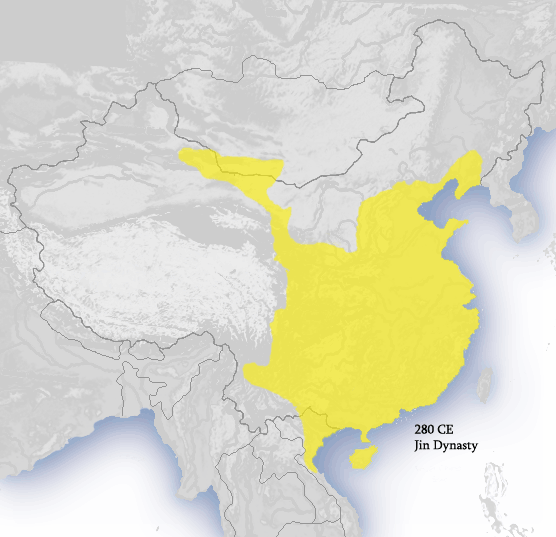
File:Western Jeun Dynasty 280 CE.png


The Jin dynasty, distinguished as the Sima Jin and Liang Jin, was a Chinese dynasty, empire, and era traditionally dated from AD 265 to 420. It was founded by Sima Yan, son of Sima Zhao who was created Prince of Jin and posthumously declared the founder of the dynasty. It followed the Three Kingdoms period (220-280 AD), which ended with the conquest of Eastern Wu by the Jin.
There are two main divisions in the history of the dynasty: the Western Jin (265–316) when the capital was located at Luoyang or Chang'an (modern Xi'an) and the Eastern Jin (317–420) when it was relocated to Jiankang (modern Nanjing). Sima Rui was forced to relocated to Jiankang owing to civil wars and invasion from the Five Barbarians of the north and west. The Eastern Jin was eventually overthrown by the Liu Song.


Under the Wei, who emerged victorious from China's Three Kingdoms period, the Sima clan rose to prominence, particularly after the 249 coup d'état at the Gaoping Tombs. Sima Zhao assisted the throne in suppressing other rebellions, recovering Shu and capturing Liu Shan in 263 and opposing Zhong Hui's rebellion the next year. His ambitions for the throne remain proverbial in Chinese but he died before he could rise higher than prince of Jin, a title named for the Zhou-era marchland and duchy around Shaanxi's Jin River. (He was granted the title as his ancestral home was located in Wen County within Jin's former lands.)
The Jin dynasty was founded in AD 265 by Sima Yan, posthumously known as Emperor Wu (the "Martial Emperor of Jin"). He forced Cao Huan's abdication but permitted him to live in honor as the prince of Chenliu and buried him with imperial ceremony. There was a brief period of Chinese unity following the conquest of Eastern Wu in 280, but the state was soon weakened by corruption, political turmoil, and internal conflicts. Sima Yan's son Zhong, posthumously known as Emperor Hui (the "Benevolent Emperor of Jin"), was developmentally disabled. Conflict over his succession in 290 expanded into the devastating War of the Eight Princes. Afterwards, the empire was too weak to resist the uprisings and invasions of the Wu Hu (the "Five Barbarians"). Large numbers of Chinese fled south from the Central Plains; among other effects, these refugees and colonizers gave Quanzhou's Jin River its name as they settled its valley in Fujian. The Jin capital Luoyang was captured by Liu Cong in 311. Sima Chi, posthumously known as Emperor Huai (the "Missing Emperor of Jin"), was captured and later executed. His successor Sima Ye, posthumously known as Emperor Min (the "Suffering Emperor of Jin"), was captured at Chang'an (present-day Xi'an) in 316 and also later executed.[1]
The remnants of the Jin court fled to the east, reëstablishing their government at Jiankang within present-day Nanjing, Jiangsu. Sima Rui, the prince of Langye, was enthroned in 318, posthumously becoming known as Emperor Yuan (the "First Emperor of the Eastern Jin").[1] The rival northern states, who denied the legitimacy of his succession, sometimes referred to his state as "Langye". The Emperors of Eastern Jin had limited power, owing to their dependence on the support of both local and refugee noble families (notably the Huan, Wang, and Xie) which possessed military power. Although there was a stated goal of recovering the "lost northern lands", paranoia within the royal family and a constant string of disruptions to the throne caused the loss of support among many officials. Military crises—including the rebellions of the generals Wang Dun and Su Jun but also lesser fangzhen (方鎮, "military county") revolts—plagued the Eastern Jin throughout its 104 years of existence.
...

09 Three Kingdoms Period

Three Kingdoms Period

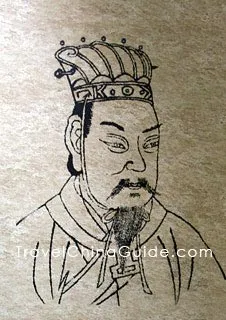
Cao Cao
Cao Cao
Just as the name implies, the Three Kingdoms were made up of three kingdoms - Wei, Shu and Wu. As a single dynasty, the Three Kingdoms Period originated in 220 AD when Wei replaced the Eastern Han Dynasty (25 AD-220 AD) and ended in 280 AD when the Wu was defeated by the Court of Jin. It is considered to be a special historical period full of power struggles and sophisticated military strategies.
 Political History

In 189 when Emperor Ling of the Eastern Han dynasty died, a young emperor - Emperor Shao was put on the throne. Resenting the manipulation of eunuchs, two generals Yuan Shao and He Jin plotted to murder them. During the chaos caused by the fighting between the eunuchs and generals, Dong Zhuo, a treacherous court official of the Eastern Han drove his army into Luoyang. With full political power in his hand, Dong Zhuo dethroned Emperor Shao and put Emperor Xian on the throne. All Dong's deeds aroused strong protest from the courtiers and many local officials. As the political situation became acute, a large-scale civil war finally broke out.
After Dong Zhuo invaded Luoyang, Cao Cao fled to Chenliu (currently southeast of Kaifeng in Henan Province) and began to assemble military forces to revolt. In 193, Dong was killed in a mutiny but the melee remained. This period of unrest continued until 196, Balkanized areas were formed among which the most two powerful ones were those of Yuan Shao and Cao Cao.
In 196, Cao Cao held Emperor Xian under duress and took this advantage to strengthen his military power. In 201, with comparatively weaker strength, Cao Cao defeated Yuan  Shao in the Battle of Guandu after which he gradually unified the northern area of China. In 209, Cao Cao drove his troops to the southern area and captured Jingzhou. But when he wanted to expand his power further to the south, he was defeated by the allied forces of Liu Bei and Sun Quan in the Battle of Red Cliff and thus he withdrew his army back to the central plains of China.
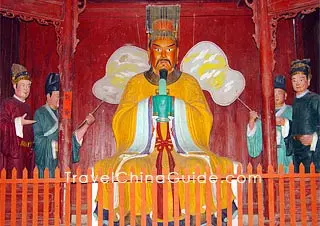
Liu Bei
Liu Bei
In 220 when Cao Cao died, his eldest son Cao Pi proclaimed himself emperor, with Wei as his National Title and Luoyang as his capital city. In 221, Liu Bei proclaimed himself emperor, with Shu his national title and Chengdu the capital city. And in 229, Sun Quan proclaimed himself emperor in Wuchang (currently Wuhan), and later moved the capital to Jiankang (currently Nanjing), with the national title Wu. Since then, the so-called Three Kingdoms' Tripartite Confrontation was formed. On the whole, Wei occupied the north, Shu occupied the southwest and Wu occupied the southeast.
Upon the founding of the three kingdoms, rulers of each kingdom all committed to improve the way of ruling and develop their national economy. In the Kingdom of Wei, Cao Cao made many reforms to discard old policies inform previous dynasties. The Tun Tian  (farming done by soldiers) System was also carried out, which greatly promoted the national productivity. In the Kingdom of Shu, Zhuge Liang set up strict social order and tried to govern the kingdom by law. With his assistance, Shu's agriculture and handicraft industry developed rapidly. Additionally, Shu formed a friendly relationship with ethnic minorities in southwestern areas. In the Kingdom of Wu, the shipbuilding industry was much more prosperous. As for the national strength, Wei ranked first, Wu second and Shu third.
Throughout the Three Kingdoms Period, battles between the three countries were countless. Among those, battles between Shu and Wu fighting for Jingzhou, Shu and Wei fighting for Hanzhong as well as Wei defeating Shu were all illustrious ones in Chinese history.
Finally, the end of the Three Kingdoms Period started from the Sima Yan (son of Sima Yi and chancellor of Wei)'s usurpation of Wei and the establishment of the Jin Dynasty (265 - 420). In 282 when the Jin army conquered the last kingdom - Wu's capital, the Three Kingdoms Period was ended.
 Emperors during this period
Order
Name
Notes
Reign Time (years)
Kingdom of Wei (220-265)
1 Wei Wendi
(Cao Pi)
The second son of the Chinese politician and poet Cao Cao; he is considered the founder of Wei 220 - 226
2  Wei Mingdi
(Cao Rui)
Son of Cao Pi; during his reign, the Shu and Wu become more entrenched. Before he died, he entrusted his son Cao Fang to the regency of Cao Shuang and Sima Yi - ultimately a fatal mistake for his empire. 226 - 239
3 Wei Qiwang (Cao Fang) Adopted son of Cao Rui, he was rumored to be the son of Cao Kai who was a grandson of Cao Cao. Although, he reigned longer than any other emperor in Wei's history, he did not have any real imperial authority. He was eventually deposed by Sima Yi. 239 - 254
4 Gaoguixiang Gong
(Cao Mao)
A grandson of Cao Pi, his reign was under the domination of the Simas. He attempted a coup against Sima Zhao, but was killed by Sima's troop. 254 - 260
5 Wei Yuandi (Cao Huan) A grandson of Cao Cao, and the last emperor of Wei who was still a figurehead of the Simas. During his reign, the Shu was defeated by the Wei. He was forced to abdicate by Sima Yan, and was given the title of "Prince of Chenliu" which he retained for the rest of his life. 260 - 265
Kingdom of Shu (221-263)
1 Zhao Liedi (Liu Bei) A descendant of the Western Han (206 BC - 24 AD) imperial family and born into the commoner class. With military counselor Zhuge Liang's assistance, he founded Shu and became the first emperor of the Shu. 221 - 223
2 Hou Zhu
(Liu Chan)
The second and last emperor of Shu. During his reign, he surrendered to the Kingdom of Wei in 263. 223 - 263
Kingdom of Wu (222-280)
1  Dadi
(Sun Quan)
Son of Sun Jian and founder of Wu, Sun Quan had the longest reign among the emperors of Wu 222 - 252
2 Kuai ji wang
(Sun Liang)
Sun Quan's youngest son and heir, he was known as the Prince of Kuaiji , a title given to him after he was removed by the regent Sun Lin 252 - 258
3    Jingdi
(Sun Xiu)
Another son of Sun Quan and brother of Sun Liang, Sun Xu was known for being tolerant of differing opinions and for being studious 258 - 264
4 Wen Cheng Hou
(Sun Hao)
The eldest son of Sun He and a crown prince of the first emperor Sun Quan. During his reign, he surrendered to the Jin Court. 264 - 280

08-4 Confucius and Education

4. Confucius and Education

A hallmark of Confucius' thought is his emphasis on education and study. He disparages those who have faith in natural understanding or intuition and argues that the only real understanding of a subject comes from long and careful study. Study, for Confucius, means finding a good teacher and imitating his words and deeds. A good teacher is someone older who is familiar with the ways of the past and the practices of the ancients. (See Lunyu 7.22) While he sometimes warns against excessive reflection and meditation, Confucius' position appears to be a middle course between learning and reflecting on what one has learned. “He who learns but does not think is lost. He who thinks but does not learn is in great danger” (Lunyu 2.15).[23] He taught his students morality, proper speech, government, and the refined arts. While he also emphasizes the “Six Arts” — ritual, music, archery, chariot-riding, calligraphy, and computation — it is clear that he regards morality as the most important subject. Confucius' pedagogical methods are striking. He never discourses at length on a subject. Instead he poses questions, cites passages from the classics, or uses apt analogies, and waits for his students to arrive at the right answers. “Only for one deeply frustrated over what he does not know will I provide a start; only for one struggling to form his thoughts into words will I provide a beginning. But if I hold up one corner and he cannot respond with the other three I will not repeat myself” (Lunyu 7.8).
Confucius' goal is to create gentlemen who carry themselves with grace, speak correctly, and demonstrate integrity in all things. His strong dislike of the sycophantic “petty men,” whose clever talk and pretentious manner win them an audience, is reflected in numerous Lunyu passages. Confucius finds himself in an age in which values are out of joint. Actions and behavior no longer correspond to the labels originally attached to them. “Rulers do not rule and subjects do not serve,” he observes. (Lunyu 12.11; cf. also 13.3) This means that words and titles no longer mean what they once did. Moral education is important to Confucius because it is the means by which one can rectify this situation and restore meaning to language and values to society. He believes that the most important lessons for obtaining such a moral education are to be found in the canonical Book of Songs, because many of its poems are both beautiful and good. Thus Confucius places the text first in his curriculum and frequently quotes and explains its lines of verse. For this reason, the Lunyu is also an important source for Confucius' understanding of the role poetry and art more generally play in the moral education of gentlemen as well as in the reformation of society. Recent archaeological discoveries in China of previously lost ancient manuscripts reveal other aspects of Confucius's reverence for the Book of Songs and its importance in moral education. These manuscripts show that Confucius had found in the canonical text valuable lessons on how to cultivate moral qualities in oneself as well as how to comport oneself humanely and responsibly in public.

08-3 Confucius' Political Philosophy

Confucius' Political Philosophy

Confucius' political philosophy is also rooted in his belief that a ruler should learn self-discipline, should govern his subjects by his own example, and should treat them with love and concern. “If the people be led by laws, and uniformity among them be sought by punishments, they will try to escape punishment and have no sense of shame. If they are led by virtue, and uniformity sought among them through the practice of ritual propriety, they will possess a sense of shame and come to you of their own accord” (Lunyu 2.3; see also 13.6.). It seems apparent that in his own day, however, advocates of more legalistic methods were winning a large following among the ruling elite. Thus Confucius' warning about the ill consequences of promulgating law codes should not be interpreted as an attempt to prevent their adoption but instead as his lament that his ideas about the moral suasion of the ruler were not proving popular.
Most troubling to Confucius was his perception that the political institutions of his day had completely broken down. He attributed this collapse to the fact that those who wielded power as well as those who occupied subordinate positions did so by making claim to titles for which they were not worthy. When asked by a ruler of the large state of Qi, Lu's neighbor on the Shandong peninsula, about the principles of good government, Confucius is reported to have replied: “Good government consists in the ruler being a ruler, the minister being a minister, the father being a father, and the son being a son” (Lunyu 12.11). I should claim for myself only a title that is legitimately mine and when I possess such a title and participate in the various hierarchical relationships signified by that title, then I should live up to the meaning of the title that I claim for myself. Confucius' analysis of the lack of connection between actualities and their names and the need to correct such circumstances is often referred to as Confucius' theory of zhengming. Elsewhere in the Analects, Confucius says to his disciple Zilu that the first thing he would do in undertaking the administration of a state is zhengming. (Lunyu 13.3). In that passage Confucius is taking aim at the illegitimate ruler of Wei who was, in Confucius' view, improperly using the title “successor,” a title that belonged to his father the rightful ruler of Wei who had been forced into exile.[22] Xunzi composed an entire essay entitled Zhengming. But for Xunzi the term referred to the proper use of language and how one should go about inventing new terms that were suitable to the age. For Confucius, zhengming does not seem to refer to the ‘rectification of names’ (this is the way the term is most often translated by scholars of the Analects), but instead to rectifying the behavior of people and the social reality so that they correspond to the language with which people identify themselves and describe their roles in society. Confucius believed that this sort of rectification had to begin at the very top of the government, because it was at the top that the discrepancy between names and actualities had originated. If the ruler's behavior is rectified then the people beneath him will follow suit. In a conversation with Ji Kangzi (who had usurped power in Lu), Confucius advised: “If your desire is for good, the people will be good. The moral character of the ruler is the wind; the moral character of those beneath him is the grass. When the wind blows, the grass bends” (Lunyu 12.19).
For Confucius, what characterized superior rulership was the possession of de or ‘virtue.’ Conceived of as a kind of moral power that allows one to win a following without recourse to physical force, such ‘virtue’ also enabled the ruler to maintain good order in his state without troubling himself and by relying on loyal and effective deputies. Confucius claimed that, “He who governs by means of his virtue is, to use an analogy, like the pole-star: it remains in its place while all the lesser stars do homage to it” (Lunyu 2.1). The way to maintain and cultivate such royal ‘virtue’ was through the practice and enactment of li or ‘rituals’—the ceremonies that defined and punctuated the lives of the ancient Chinese aristocracy. These ceremonies encompassed: the sacrificial rites performed at ancestral temples to express humility and thankfulness; the ceremonies of enfeoffment, toasting, and gift exchange that bound together the aristocracy into a complex web of obligation and indebtedness; and the acts of politeness and decorum—such things as bowing and yielding—that identified their performers as gentlemen. In an influential study, Herbert Fingarette argues that the performance of these various ceremonies, when done correctly and sincerely, involves a ‘magical’ quality that underlies the efficacy of royal ‘virtue’ in accomplishing the aims of the ruler.

4. Confucius and Education

A hallmark of Confucius' thought is his emphasis on education and study. He disparages those who have faith in natural understanding or intuition and argues that the only real understanding of a subject comes from long and careful study. Study, for Confucius, means finding a good teacher and imitating his words and deeds. A good teacher is someone older who is familiar with the ways of the past and the practices of the ancients. (See Lunyu 7.22) While he sometimes warns against excessive reflection and meditation, Confucius' position appears to be a middle course between learning and reflecting on what one has learned. “He who learns but does not think is lost. He who thinks but does not learn is in great danger” (Lunyu 2.15).[23] He taught his students morality, proper speech, government, and the refined arts. While he also emphasizes the “Six Arts” — ritual, music, archery, chariot-riding, calligraphy, and computation — it is clear that he regards morality as the most important subject. Confucius' pedagogical methods are striking. He never discourses at length on a subject. Instead he poses questions, cites passages from the classics, or uses apt analogies, and waits for his students to arrive at the right answers. “Only for one deeply frustrated over what he does not know will I provide a start; only for one struggling to form his thoughts into words will I provide a beginning. But if I hold up one corner and he cannot respond with the other three I will not repeat myself” (Lunyu 7.8).
Confucius' goal is to create gentlemen who carry themselves with grace, speak correctly, and demonstrate integrity in all things. His strong dislike of the sycophantic “petty men,” whose clever talk and pretentious manner win them an audience, is reflected in numerous Lunyu passages. Confucius finds himself in an age in which values are out of joint. Actions and behavior no longer correspond to the labels originally attached to them. “Rulers do not rule and subjects do not serve,” he observes. (Lunyu 12.11; cf. also 13.3) This means that words and titles no longer mean what they once did. Moral education is important to Confucius because it is the means by which one can rectify this situation and restore meaning to language and values to society. He believes that the most important lessons for obtaining such a moral education are to be found in the canonical Book of Songs, because many of its poems are both beautiful and good. Thus Confucius places the text first in his curriculum and frequently quotes and explains its lines of verse. For this reason, the Lunyu is also an important source for Confucius' understanding of the role poetry and art more generally play in the moral education of gentlemen as well as in the reformation of society. Recent archaeological discoveries in China of previously lost ancient manuscripts reveal other aspects of Confucius's reverence for the Book of Songs and its importance in moral education. These manuscripts show that Confucius had found in the canonical text valuable lessons on how to cultivate moral qualities in oneself as well as how to comport oneself humanely and responsibly in public.

08-2 Confucius' Ethics

Confucius' Ethics

Confucius' teachings and his conversations and exchanges with his disciples are recorded in the Lunyu or Analects, a collection that probably achieved something like its present form around the second century BCE. While Confucius believes that people live their lives within parameters firmly established by Heaven—which, often, for him means both a purposeful Supreme Being as well as ‘nature’ and its fixed cycles and patterns—he argues that men are responsible for their actions and especially for their treatment of others. We can do little or nothing to alter our fated span of existence but we determine what we accomplish and what we are remembered for.
Confucius represented his teachings as lessons transmitted from antiquity. He claimed that he was “a transmitter and not a maker” and that all he did reflected his “reliance on and love for the ancients” (Lunyu 7.1). Confucius pointed especially to the precedents established during the height of the royal Zhou (roughly the first half of the first millennium BCE). Such justifications for one's ideas may have already been conventional in Confucius' day. Certainly his claim that there were antique precedents for his ideology had a tremendous influence on subsequent thinkers many of whom imitated these gestures. But we should not regard the contents of the Analects as consisting of old ideas. Much of what Confucius taught appears to have been original to him and to have represented a radical departure from the ideas and practices of his day.
Confucius also claimed that he enjoyed a special and privileged relationship with Heaven and that, by the age of fifty, he had come to understand what Heaven had mandated for him and for mankind. (Lunyu 2.4). Confucius was also careful to instruct his followers that they should never neglect the offerings due Heaven. (Lunyu 3.13) Some scholars have seen a contradiction between Confucius' reverence for Heaven and what they believe to be his skepticism with regard to the existence of ‘the spirits.’ But the Analects passages that reveal Confucius' attitudes toward spiritual forces (Lunyu 3.12, 6.20, and 11.11) do not suggest that he was skeptical. Rather they show that Confucius revered and respected the spirits, thought that they should be worshipped with utmost sincerity, and taught that serving the spirits was a far more difficult and complicated matter than serving mere mortals.
Confucius' social philosophy largely revolves around the concept of ren, “compassion” or “loving others.” Cultivating or practicing such concern for others involved deprecating oneself. This meant being sure to avoid artful speech or an ingratiating manner that would create a false impression and lead to self-aggrandizement. (Lunyu 1.3) Those who have cultivated ren are, on the contrary, “simple in manner and slow of speech” (Lunyu 13.27). For Confucius, such concern for others is demonstrated through the practice of forms of the Golden Rule: “What you do not wish for yourself, do not do to others;” “Since you yourself desire standing then help others achieve it, since you yourself desire success then help others attain it” (Lunyu 12.2, 6.30). He regards devotion to parents and older siblings as the most basic form of promoting the interests of others before one's own. Central to all ethical teachings found in the Analects of Confucius is the notion that the social arena in which the tools for creating and maintaining harmonious relations are fashioned and employed is the extended family. Among the various ways in which social divisions could have been drawn, the most important were the vertical lines that bound multigenerational lineages. And the most fundamental lessons to be learned by individuals within a lineage were what role their generational position had imposed on them and what obligations toward those senior or junior to them were associated with those roles. In the world of the Analects, the dynamics of social exchange and obligation primarily involved movement up and down along familial roles that were defined in terms of how they related to others within the same lineage. It was also necessary that one play roles within other social constructs—neighborhood, community, political bureaucracy, guild, school of thought—that brought one into contact with a larger network of acquaintances and created ethical issues that went beyond those that impacted one's family. But the extended family was at the center of these other hierarchies and could be regarded as a microcosm of their workings. One who behaved morally in all possible parallel structures extending outward from the family probably approximated Confucius's conception of ren.
It is useful to contrast this conception of ren and the social arena in which it worked with the idea of jian ai or “impartial love” advocated by the Mohists who as early as the fifth century BCE posed the greatest intellectual challenge to Confucius' thought. The Mohists shared with Confucius and his followers the goal of bringing about effective governance and a stable society, but they constructed their ethical system, not on the basis of social roles, but rather on the self or, to be more precise, the physical self that has cravings, needs, and ambitions. For the Mohists, the individual's love for his physical self is the basis on which all moral systems had to be built. The Confucian emphasis on social role rather than on the self seems to involve, in comparison to the Mohist position, an exaggerated emphasis on social status and position and an excessive form of self-centeredness. While the Mohist love of self is also of course a form of self-interest, what distinguishes it from the Confucian position is that the Mohists regard self-love as a necessary means to an end, not the end in itself, which the Confucian pride of position and place appears to be. The Mohist program called for a process by which self-love was replaced by, or transformed into, impartial love—the unselfish and altruistic concern for others that would, in their reckoning, lead to an improved world untroubled by wars between states, conflict in communities, and strife within families. To adopt impartial love would be to ignore the barriers that privilege the self, one's family, and one's state and that separate them from other individuals, families, and states. In this argument, self-love is a fact that informs the cultivation of concern for those within one's own silo; it is also the basis for interacting laterally with those to whom one is not related, a large cohort that is not adequately taken into account in the Confucian scheme of ethical obligation.
Confucius taught that the practice of altruism he thought necessary for social cohesion could be mastered only by those who have learned self-discipline. Learning self-restraint involves studying and mastering li, the ritual forms and rules of propriety through which one expresses respect for superiors and enacts his role in society in such a way that he himself is worthy of respect and admiration. A concern for propriety should inform everything that one says and does:
Look at nothing in defiance of ritual, listen to nothing in defiance of ritual, speak of nothing in defiance or ritual, never stir hand or foot in defiance of ritual. (Lunyu 12.1)
Subjecting oneself to ritual does not, however, mean suppressing one's desires but instead learning how to reconcile one's own desires with the needs of one's family and community. Confucius and many of his followers teach that it is by experiencing desires that we learn the value of social strictures that make an ordered society possible (See Lunyu 2.4.). And at least for Confucius' follower Zi Xia, renowned in the later tradition for his knowledge of the Book of Songs, one's natural desires for sex and other physical pleasures were a foundation for cultivating a passion for worthiness and other lofty ideals (Lunyu 1.7).[21]
Confucius' emphasis on ritual does not mean that he was a punctilious ceremonialist who thought that the rites of worship and of social exchange had to be practiced correctly at all costs. Confucius taught, on the contrary, that if one did not possess a keen sense of the well-being and interests of others his ceremonial manners signified nothing. (Lunyu 3.3) Equally important was Confucius' insistence that the rites not be regarded as mere forms, but that they be practiced with complete devotion and sincerity. “He [i.e., Confucius] sacrificed to the dead as if they were present. He sacrificed to the spirits as if the spirits were present. The Master said, ‘I consider my not being present at the sacrifice as though there were no sacrifice’” (Lunyu 3.12).

3. Confucius' Political Philosophy

Confucius' political philosophy is also rooted in his belief that a ruler should learn self-discipline, should govern his subjects by his own example, and should treat them with love and concern. “If the people be led by laws, and uniformity among them be sought by punishments, they will try to escape punishment and have no sense of shame. If they are led by virtue, and uniformity sought among them through the practice of ritual propriety, they will possess a sense of shame and come to you of their own accord” (Lunyu 2.3; see also 13.6.). It seems apparent that in his own day, however, advocates of more legalistic methods were winning a large following among the ruling elite. Thus Confucius' warning about the ill consequences of promulgating law codes should not be interpreted as an attempt to prevent their adoption but instead as his lament that his ideas about the moral suasion of the ruler were not proving popular.
Most troubling to Confucius was his perception that the political institutions of his day had completely broken down. He attributed this collapse to the fact that those who wielded power as well as those who occupied subordinate positions did so by making claim to titles for which they were not worthy. When asked by a ruler of the large state of Qi, Lu's neighbor on the Shandong peninsula, about the principles of good government, Confucius is reported to have replied: “Good government consists in the ruler being a ruler, the minister being a minister, the father being a father, and the son being a son” (Lunyu 12.11). I should claim for myself only a title that is legitimately mine and when I possess such a title and participate in the various hierarchical relationships signified by that title, then I should live up to the meaning of the title that I claim for myself. Confucius' analysis of the lack of connection between actualities and their names and the need to correct such circumstances is often referred to as Confucius' theory of zhengming. Elsewhere in the Analects, Confucius says to his disciple Zilu that the first thing he would do in undertaking the administration of a state is zhengming. (Lunyu 13.3). In that passage Confucius is taking aim at the illegitimate ruler of Wei who was, in Confucius' view, improperly using the title “successor,” a title that belonged to his father the rightful ruler of Wei who had been forced into exile.[22] Xunzi composed an entire essay entitled Zhengming. But for Xunzi the term referred to the proper use of language and how one should go about inventing new terms that were suitable to the age. For Confucius, zhengming does not seem to refer to the ‘rectification of names’ (this is the way the term is most often translated by scholars of the Analects), but instead to rectifying the behavior of people and the social reality so that they correspond to the language with which people identify themselves and describe their roles in society. Confucius believed that this sort of rectification had to begin at the very top of the government, because it was at the top that the discrepancy between names and actualities had originated. If the ruler's behavior is rectified then the people beneath him will follow suit. In a conversation with Ji Kangzi (who had usurped power in Lu), Confucius advised: “If your desire is for good, the people will be good. The moral character of the ruler is the wind; the moral character of those beneath him is the grass. When the wind blows, the grass bends” (Lunyu 12.19).
For Confucius, what characterized superior rulership was the possession of de or ‘virtue.’ Conceived of as a kind of moral power that allows one to win a following without recourse to physical force, such ‘virtue’ also enabled the ruler to maintain good order in his state without troubling himself and by relying on loyal and effective deputies. Confucius claimed that, “He who governs by means of his virtue is, to use an analogy, like the pole-star: it remains in its place while all the lesser stars do homage to it” (Lunyu 2.1). The way to maintain and cultivate such royal ‘virtue’ was through the practice and enactment of li or ‘rituals’—the ceremonies that defined and punctuated the lives of the ancient Chinese aristocracy. These ceremonies encompassed: the sacrificial rites performed at ancestral temples to express humility and thankfulness; the ceremonies of enfeoffment, toasting, and gift exchange that bound together the aristocracy into a complex web of obligation and indebtedness; and the acts of politeness and decorum—such things as bowing and yielding—that identified their performers as gentlemen. In an influential study, Herbert Fingarette argues that the performance of these various ceremonies, when done correctly and sincerely, involves a ‘magical’ quality that underlies the efficacy of royal ‘virtue’ in accomplishing the aims of the ruler.

4. Confucius and Education

A hallmark of Confucius' thought is his emphasis on education and study. He disparages those who have faith in natural understanding or intuition and argues that the only real understanding of a subject comes from long and careful study. Study, for Confucius, means finding a good teacher and imitating his words and deeds. A good teacher is someone older who is familiar with the ways of the past and the practices of the ancients. (See Lunyu 7.22) While he sometimes warns against excessive reflection and meditation, Confucius' position appears to be a middle course between learning and reflecting on what one has learned. “He who learns but does not think is lost. He who thinks but does not learn is in great danger” (Lunyu 2.15).[23] He taught his students morality, proper speech, government, and the refined arts. While he also emphasizes the “Six Arts” — ritual, music, archery, chariot-riding, calligraphy, and computation — it is clear that he regards morality as the most important subject. Confucius' pedagogical methods are striking. He never discourses at length on a subject. Instead he poses questions, cites passages from the classics, or uses apt analogies, and waits for his students to arrive at the right answers. “Only for one deeply frustrated over what he does not know will I provide a start; only for one struggling to form his thoughts into words will I provide a beginning. But if I hold up one corner and he cannot respond with the other three I will not repeat myself” (Lunyu 7.8).
Confucius' goal is to create gentlemen who carry themselves with grace, speak correctly, and demonstrate integrity in all things. His strong dislike of the sycophantic “petty men,” whose clever talk and pretentious manner win them an audience, is reflected in numerous Lunyu passages. Confucius finds himself in an age in which values are out of joint. Actions and behavior no longer correspond to the labels originally attached to them. “Rulers do not rule and subjects do not serve,” he observes. (Lunyu 12.11; cf. also 13.3) This means that words and titles no longer mean what they once did. Moral education is important to Confucius because it is the means by which one can rectify this situation and restore meaning to language and values to society. He believes that the most important lessons for obtaining such a moral education are to be found in the canonical Book of Songs, because many of its poems are both beautiful and good. Thus Confucius places the text first in his curriculum and frequently quotes and explains its lines of verse. For this reason, the Lunyu is also an important source for Confucius' understanding of the role poetry and art more generally play in the moral education of gentlemen as well as in the reformation of society. Recent archaeological discoveries in China of previously lost ancient manuscripts reveal other aspects of Confucius's reverence for the Book of Songs and its importance in moral education. These manuscripts show that Confucius had found in the canonical text valuable lessons on how to cultivate moral qualities in oneself as well as how to comport oneself humanely and responsibly in public.